








If you enjoyed last year’s tech fiction roundup, you’re in luck. Alexandra Paulus has once again compiled a list of tech policy experts’ top reads for your holiday downtime. These novels explore technology’s power, promises, and pitfalls – what it means for the self and the other, community and communication, and conflict and subversion. And of course, there are plenty of familiar scenarios, including AI-led dystopias and civilisations of interplanetary travellers.
With settings ranging from the deep sea to outer space, from the past to a distant future, these books won’t necessarily offer a solution to the problems of our current world, but they’ll certainly provide a temporary escape.
An empire built on the power of language
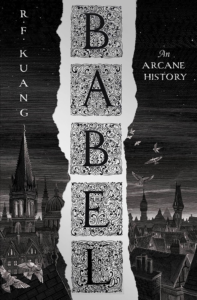
Set in an alternative 19th century, ‘Babel, or the Necessity of Violence’ depicts a world in which the British colonial empire sustains itself with an unusual technology. Academics at the Oxford Royal Institute of Translation (nicknamed Babel) have endowed silver mined in the colonies with magical powers by exploiting subtle differences in meaning between words in different languages.
The novel follows Robin Swift, who was born in part of China colonised by Britain and brought to England as a child. Later, while a translator at Babel, he joins a resistance movement. Beyond colonialism and resistance, Kuang ponders questions that resonate with current debates: How can we mitigate the effects of technologies that could render human labour obsolete? And who keeps the technology giants in check? In addition to being a study on tech and ethics, the book is a treasure trove for language nerds.
Alexandra Paulus, German Institute for International and Security Affairs (SWP), recommends ‘Babel, or the Necessity of Violence’ by R. F. Kuang.
Eco-terrorist, anti-civver, or philosopher king?
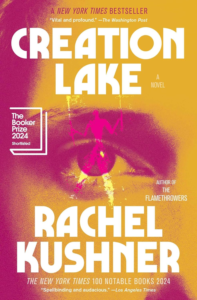
‘Sadie Smith’ (as she calls herself) is a former government agent turned shadowy spy in this eco-terrorism thriller by Rachel Kushner. Tasked with infiltrating a group of environmental activists suspected of sabotaging machinery in rural France, Sadie’s role is to unearth anti-social behaviour and engineer a violent confrontation that will destroy the organisation entirely. Yet Sadie finds herself slowly pulled into the group’s hypnotic philosophy of extreme anti-capitalism. The organisation’s mentor, a theorist of Neanderthal behaviour who espouses the species’ superiority over Homo Sapiens, promotes a brand of anti-civilisation, or ‘anti-civ’, philosophy that is at direct odds with Sadie’s work as a covert operative.
Balancing a propulsive plot with a meditation on paleoanthropology, ‘Creation Lake’ reconsiders technology’s very role in building and advancing human civilisation. Kushner weaves the two seemingly incongruous branches of the novel, political intrigue and environmental theory, together in a way that leaves readers with a strange sense of discomfort with the present, confusion over the past, and deep concern about the future.
Taylor Grossman, Institute for Security and Technology, recommends ‘Creation Lake’ by Rachel Kushner.
If you could restore balance, what would you do?
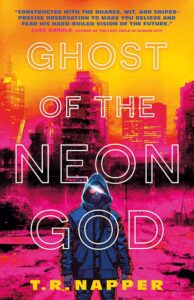
Jackson Nguyen is an Australian petty criminal with no permanent residence. When he and his pal Col Charles stumble across a Chinese woman begging for help in Melbourne, everything changes. The technology wired into their brains censors the specifics when she tries to explain her situation, and anyway, neither Jackson nor Col take much notice. Still, the woman’s persecutors aren’t taking any chances. The two friends, who had absolutely no intention of getting involved in any major conflict, suddenly have to flee across the continent.
‘Ghost of the Neon God’ begins in signature TR Napper style: a vivid near-future setting that’s as dark as a broken neon light. He shows empathy for the underdog and reveals their very human motive – pure survival. If you like dark, dystopian science-fiction where those without power have to find their way, Napper is a sure bet. Differing slightly from his usual style, ‘Ghost of the Neon God’ offers a less explicit, sometimes comedic read.
Christoph Lobmeyer, Deutsche Cyber-Sicherheitsorganisation (DCSO) recommends ‘Ghost of the Neon God’ by TR Napper.
A remote island, intelligent octopuses, and corporate power
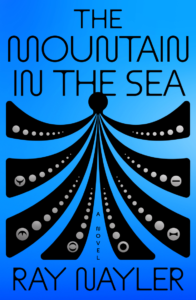
On one level, ‘The Mountain in the Sea’ is a philosophical exploration of intelligence and community. It juxtaposes human experience with that of animals and machines, thereby challenging readers to reflect on consciousness, and how conscious beings create and sustain complex social structures. Set in an ambiguous near future, it also serves as a chilling cautionary tale about unchecked corporate power. One particularly haunting image is that of an AI-controlled fish trawler, where human slaves toil endlessly under an algorithm designed to maximise output, with no hope of ever escaping alive.
Yet the heart of the story unfolds on a secluded island, where a researcher arrives to study an octopus believed to demonstrate both consciousness and intricate social behaviors. The protagonist is accompanied by an AI-powered droid and a mercenary, each offering their own unique perspective on intelligence and connection, in a narrative that weaves together existential questions of consciousness, agency and responsibility, stark warnings, and glimmers of hope. While it sounds like a lot, Ray Nayler finds a way to raise these big issues in a highly entertaining way.
Daniel Voelsen, SWP, recommends ‘The Mountain in the Sea’ by Ray Nayler.
From the deep sea to deep space
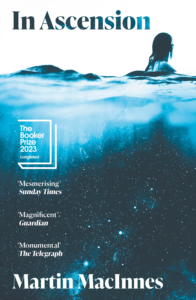
‘In Ascension’ creeps up on you – you don’t notice you’re reading sci-fi until you’re in deep (in this case, quite literally). At the centre of Martin MacInnes’ book is Leigh Hasenbosch, a microbiologist, whose life and career we follow from her native Netherlands to the deep sea and, eventually, a long way away from Earth.
MacInnes provides a fast-paced plot and doesn’t shy away from scientific details or complex character dynamics. Refreshingly, he also never reveals which century the novel is set in. Its setting, a world racked with climate concerns and pollution, could very well be today. Verging on the philosophical, this book is as much about the human desire for exploration and the boundaries of science and knowledge as it is about relationships and family. A must read, whether or not you’re a space (or ocean!) geek.
Juliana Süß, SWP, recommends ‘In Ascension’ by Martin MacInnes.
A totalitarian regime’s revenge for planetary extinction
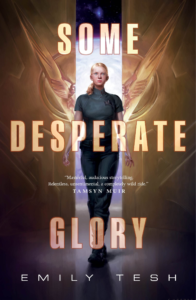
Earth no longer exists – it was destroyed by the Majo alien civilisation after their AI system, ‘The Wisdom’, determined this to be the most favourable outcome. While most humans have integrated into Majo society, a separatist group on Gaea Station is plotting revenge. ‘Some Desperate Glory’ follows Kyr, who was born and raised on Gaea. Despite her top combat scores, she is assigned to produce offspring rather than become a soldier. Enraged, she escapes the station with the help of a Majo and goes on to make history.
‘Some Desperate Glory’ starts as a fascinating portrayal of life in the Gaea totalitarian regime (Tesh reportedly took inspiration from North Korea) that is suddenly confronted with not only foreigners but also aliens (the Majo). But then, a grandiose plot twist leads to a fascinating pondering of queer identity, societies’ reliance on AI applications, and the distinction between civilisations and ‘the other’.
Alexandra Paulus, SWP, recommends ‘Some Desperate Glory’ by Emily Tesh.
There is no people beyond us
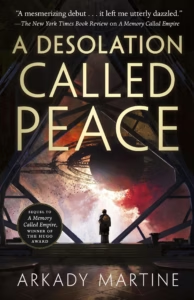
Picking up after the events of ‘A Memory Called Empire‘, ‘A Desolation Called Peace’ sees the imperial upheaval and intrigue inherited from the first book compounded by an existential new challenge: destructive first contact at the edges of known space. How will Teixcalaan and Lsel contend with one of the classic questions of science fiction?
‘A Desolation Called Peace’ is the perfect sequel, taking the enthralling setting and characters of its predecessor in radically new directions. Arkady Martine’s worldbuilding tapestry depicts a beautiful and voracious empire, the utterly alien, and literally mind-bending technology. It also asks difficult questions of the reader: what does it mean to encounter the other? How do we contend with and change in the face of fundamentally different ways of being? What does it mean to ‘be’? By the time you set down this book and reflect on its questions, rich world, and cast, the winter will have flown by.
Jiro Minier, DCSO recommends ‘A Desolation Called Peace’ by Arkady Martine.
How to stay human in a Doomsday Dungeon
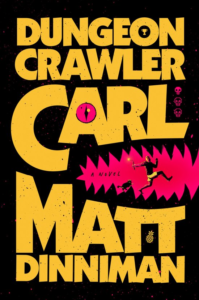
‘Dungeon Crawler Carl’ is a darkly funny, fast-paced sci-fi series by Matt Dinniman. It blends survival horror, satire, and game mechanics into a read that challenges the borders between fantasy, tech, and reality. After Earth’s surface is destroyed, survivors are forced into an ever-shifting underground dungeon designed for a deadly reality show for alien audiences. Carl, an ordinary man of extraordinary stubbornness (and his ex-fiancé’s cat, Princess Donut), must battle monsters, navigate absurd quests, outwit both players and cosmic producers, and complete challenging, inhuman tasks.
The series satirises gamer culture, capitalism, and social media spectacle while portraying character growth and interpersonal struggles. With witty humor, vivid world-building, and a lively depiction of what it means to stay human under constant surveillance, ‘Dungeon Crawler Carl’ is a page-turner that makes you question the limits of reality. A must-read for tech-savvy fans who like their dystopia with both heart and patch notes.
Lisa Lobmeyer, Security Research Labs, recommends the ‘Dungeon Crawler Carl’ series by Matt Dinniman.
One last hope for the world
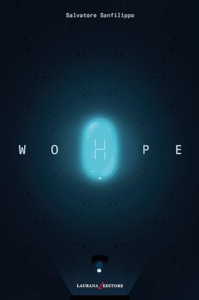
Salvatore Sanfilippo’s ‘Wohpe’ is a sharp and timely techno-thriller, set in the late 21st century in a world where everything has been automated, from art to agriculture, and work is a choice. Humanity should be prospering, yet it is facing an irreversible climate crisis. In this scenario, the only apparent solution is so-called ‘strong artificial intelligence’, which was banned twenty years earlier following a tragic accident involving a self-driving car.
Conflicts, sabotage, and heated debates create constant uncertainty around the project, and the massive system known as Wohpe (from ‘World Hope’) emerges as a final desperate attempt to save the planet and humanity. Tension builds on every page, leaving readers breathless between hope and disaster.
The ending presents a pressing question: will we ever learn what happens next?
Simona Autolitano, German Federal Office for Information Security (BSI), recommends ‘Wohpe’ by Salvatore Sanfilippo.
We are having an adventure – or are we?
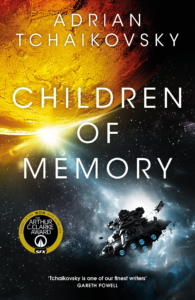
‘Children of Memory’ is the third book in the Children of Time series by Adrian Tchaikovsky. Set in Tchaikovsky’s multi-star-system universe, it follows the humans of the Imir colony as they attempt to terraform the planet. Soon, they get a creeping sense that something is terribly wrong. The crew of the spaceship Skipper observes, studies, and then feels a growing duty to save the colony. Here, we meet familiar figures from previous worlds. These include several genetically enhanced (or ‘uplifted’) species: a pair of bonded corvids, the Portiid spiders (arachnophobes please beware), octopuses. We also encounter a microbial entity called Miranda that can inhabit a human body, and Avrana Kern as an uploaded artificial mind.
‘Children of Memory’ differs from the first two books by focusing less on the interactions between uplifted species, and it sometimes feels more philosophical than fictional. Yet Tchaikovsky tackles timely questions about identity, sentience, and reality: When are we alive? How do we know if we understand? How do we remember individually and collectively? When is reality real?
Esther Kern, Brandenburg Institute for Society and Security, recommends ‘Children of Memory’ by Adrian Tchaikovsky.
Related Posts

Another year of Binding Hook!
23 December 2025
Insights from Binding Hook Live
30 October 2025

How North Korea revamped old tactics for the IT age
2 October 2025