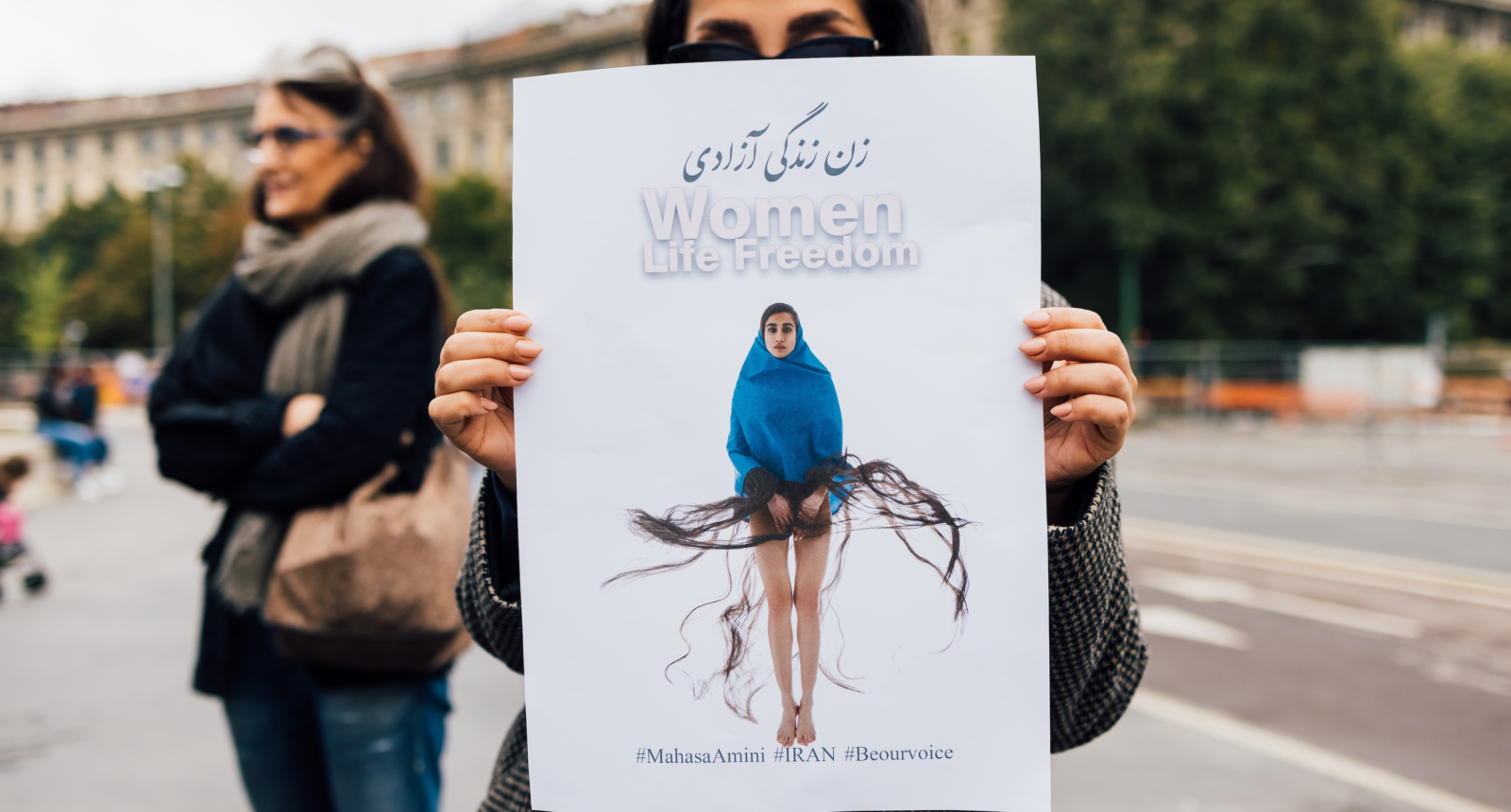

The death of Mahsa ‘Jina’ Amini, a 22-year-old Kurdish woman who was allegedly killed by Iran’s morality police for wearing her hijab improperly in September 2022, sparked unprecedented protests across Iran. While an estimated one and a half million people took to the streets, with tens of thousands arrested and hundreds killed by the authorities, another front played out online.
At the fore of these protests were women, who have used social media to defy the Islamic Republic’s censorship, document regime brutality, and mobilise support at home and abroad. Images and videos of women burning their hijabs, cutting their hair, and openly violating the state’s strict dress code have flooded digital platforms, making Iranian women’s resistance visible worldwide. In just one month after Amini’s death, the hashtag #MahsaAmini was shared more than 250 million times in Persian and over 50 million times in English.
However, this viral feminist activism has not gone uncontested. On X (formerly Twitter), both pro- and anti-regime actors weaponise misogyny – casting women protesters as immoral, unpatriotic, or agents of the West – undermining the movement and distracting from vital national issues like the struggle for democracy.
Hashtag feminism and networked misogyny in Iran
Hashtag feminism – the use of social media hashtags to promote gender equality and expose oppression – has been a powerful force globally. In Iran, it has created rare spaces for public debate about taboo subjects such as divorce, sexuality, and compulsory hijab. Prior to Amini’s death, initiatives such as ‘My Stealthy Freedom’, launched in 2014 by exiled activist Masih Alinejad, enabled women to share photos without hijabs and personal stories of discrimination. The initiative inspired campaigns like #WhiteWednesdays and #GirlsOfRevolutionStreet, laying the groundwork for online feminist resistance.
While feminist hashtag campaigns challenge patriarchal norms, they also attract intense backlash. This is not unique to Iran, but the stakes are higher in authoritarian contexts where online abuse can more easily translate into offline violence. As my recent research in Global Studies Quarterly shows, both pro- and anti-regime actors have mobilised on X (formerly Twitter) to discredit and silence women’s rights campaigners. Networked misogyny disproportionately targets female activists, aiming to exclude them from public discourse. Studies on the impact of online hate speech on vulnerable communities reveal that extremist groups often exaggerate and manipulate idealistic concepts like justice, fairness, and morality to support their hostile narratives and undermine and vilify specific individuals or groups.

Foreign agents and family shame
When it comes to women, the concept of respectability plays a crucial role, particularly in social contexts where family honour is closely tied to a woman’s behaviour. In this scenario, both truthful and fabricated claims about behaviour deemed culturally or religiously inappropriate can lead to physical violence. Online harassment, including deepfake pornography, derogatory name-calling, shaming, and threats of rape and murder, serves as a tool to silence and undermine women’s voices and experiences.
While it is difficult to know how many women are frightened into silence, one key example of this comes from neighbouring Iraq, where a female candidate for parliament, Dr. Intidhar Ahmed Jassim, withdrew from the 2018 elections due to image-based abuse – the release and circulation of a sex tape that she says was fabricated.
In Iran, both state and non-state actors have engaged in strategic framing to undermine women’s rights campaigns. Pro-regime users denounce unveiled women as morally corrupt agents of Western imperialism, invoking Islamic values to frame women’s activism as anti-religious. This misogyny often takes the form of respectability politics: activists are accused of dishonouring their families, religion, and nation.
The symbolism of hair in this context is particularly telling. Hair, as a marker of both modesty and defiance, has become a narrative battleground. During the Amini protests, women’s cutting of their hair – a gesture of pain and mourning drawn from centuries of Persian cultural history – emerged as a potent symbol of defiance. Social media amplified these acts, turning personal protest into collective rebellion.
A the same time, the comments in Persian on social media posts in response to Iranian woman activists using the #WomenLifeFreedom hashtag highlight a stark cultural and ideological divide, especially regarding modesty and the hijab. Many participants express ‘traditional values’, advocating for a return to modest attire and criticising what they see as Western-style feminist activism.
Some perceive the protests against the hijab as a betrayal of Islamic principles, while the notion of using the body for political expression is largely condemned. Pro-regime activists characterise unveiling as a slippery slope toward moral decay and more overt sexual behaviour. This is why, to discredit prominent female journalists and activists, pro-regime users portray them as sexually promiscuous and thus morally corrupt.
Humour, meanwhile, has emerged as a tool for spreading gendered hate speech under the guise of harmless banter, often through sexist memes and cartoons. This tactic lowers the threshold for sharing misogynistic content, embedding violence against women within the culture of online engagement. Images of women cutting their hair went viral, but so did caricatures and memes mocking prominent activists like Alinejad. Her distinctive curls – often adorned with a flower – were digitally distorted in degrading ways, superimposed on animals or objects to dehumanise her and trivialise her message.
Some pro-regime accounts took a different approach, framing the protests as dangerous disruptions to national unity and arguing that calls for gender equality would weaken Iran against foreign enemies. Meanwhile, anti-regime opponents of feminism accused women’s rights activists of hijacking the revolution, distracting from the central goal of regime change. Some dismissed women’s demands as secondary, to be addressed only after political victory.
The charge of foreign interference has been a particularly powerful delegitimisation tool. Women who spoke out from exile, especially in English, were labelled traitors or agents of Western powers. This accusation served to discredit both their message and their right to represent Iranian women. In the eyes of pro-regime actors, feminism became synonymous with imperialism, while some monarchists and other secular opposition groups saw it as irrelevant or even harmful to national liberation. This reflects a shared patriarchal logic: regardless of political orientation, many male-dominated factions view women primarily as symbols or tools of larger political projects, not as autonomous actors with legitimate claims.
The limits and potential of digital feminism
The Iranian women’s movement has illuminated both the power and the peril of online activism under authoritarian rule. Social media remains a double-edged sword. On the one hand, it enables Iranian women to break through censorship, connect with global allies, and create powerful visual and narrative counter-discourses. On the other hand, it exposes them to abuse and disinformation campaigns designed to delegitimise their cause.
The backlash against hashtag feminism reveals how patriarchal forces – from clerics in Tehran to monarchists in exile – use digital tools to police women’s bodies and voices. Social media companies – most based in the West – have yet to adequately address how their platforms enable and amplify these harms, particularly in authoritarian contexts. What is needed is greater attention from digital rights advocates, feminists, and policymakers to the gendered dimensions of online repression. As the global community grapples with the promises and pitfalls of digital mobilisation, Iran’s experience underscores the urgent need to confront gendered digital repression as a core challenge of our time.
Related Posts
Responsible tech business in conflict
8 March 2024
What Europe can learn from China’s technological revolution
25 September 2025
Europe needs to invest in cognitive defence
29 July 2025